London, Leeds, Exeter



Thu 26th Nov 2026
World Sustainable Transport Day 2026
Service:
Sectors: Cleantech and renewables



Liz Mills' explores how many different modes of transport she can reasonably take over the course of a year through her 'Transportation Project' marking World Sustainable Transport Day on 26 November.
Some things come as naturally to a person as breathing. For me, that’s a project. I never know in advance which project will seize me at a particular time, or where it will lead, but it brings enough chaos into my life to bring me peace.
I’ve called this year’s project “the Transportation Project”, and it’s based on seeing how many different modes of transportation a non-driver, woking full time as a Patent Attorney, can reasonably take over the course of a year.
While the Transportation Project has taken place around the world, I’m fundamentally a Londoner at heart, having been born and brought up in South Wales. Consequently, I feel compelled to evaluate how environmentally sustainable some of these different modes of transportation would be in a city like London.
So, here is my completely unscientific sustainability analysis of six transportation types in the city for World Sustainable Transport Day.
Camel Ride
You may think that camel rides are limited to the Middle East; I completed mine in Giza. However, I promise that I have photos of a camel walking the streets of London from at least one previous Lord Mayor’s parade, which at least hints at the possibility of doing something similar in a more urban environment.

From a sustainability point of view, we have to consider several factors.
First, is it safe? No. No it is not. It doesn’t feel safe (it’s much more wobbly than a horse, and you’re sat rather higher up from the ground so there’s a greater chance of achieving terminal velocity if you fall off). I advise you to disregard any photos you may have seen ofoctogenarian travellers blithely riding camels. I assume that the photos are photoshopped and the evidence of my own eyes in Giza was, in fact, a mirage. I repeat: it is not safe.
Second, is it economical? I guess this depends on where you’re doing it. It definitely wouldnot be economical in London as there are so few camels available, you’re likely going to have to pay monopoly prices.
Third, does it minimise environmental impact? Let’s say yes! I don’t know how the methane output of camels compares to that cows or horses (I am unwilling to include this on myGoogle search history), but I doubt it could be much worse, and I’m unwilling to say any animal is too environmentally impactful to exist.
Hot Air Balloon
A hot air balloon is definitely not the most practical modes of transportation (they can’t be steered and just go wherever the wind takes them, with a minivan following on the ground to take the passengers where they ultimately want to go). However, it definitely has the prettiest pictures, and that’s showbiz.
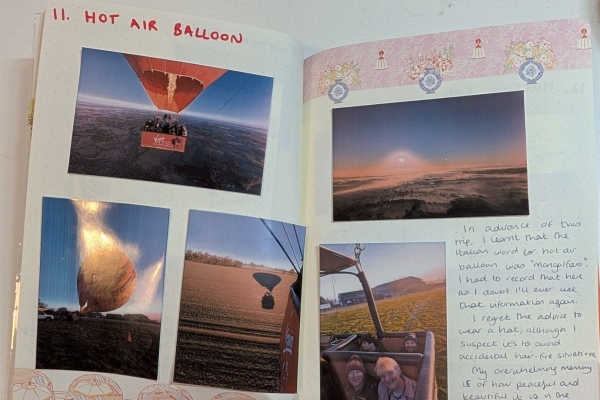
Is it safe? I did actually search this this before going in one! Google reckons that Hot Air Ballooning is the safest form of airflight. However, my insurance cost doubled by adding it to my trip itinerary for Egypt (I originally planned to ascend in Luxor, but ended up ascending in Braintree instead), so take from that what you will.
Is it economical? No. My balloon ride was comparable in cost to a helicopter ride over London that I took later in the year. It’s not really an everyday expense (even ignoring the 4am wakeup, the uncertainty of whether or not it would be cancelled, and the need to arrange alternative transportation to and from the random fields in which the action happens).
Does it minimise environmental impact? You know what, for an air flight, it’s not bad! The wind does all of the directing, while industrial fans are used for the initial inflation. There were patches on the balloon of my flight, which suggests longevity of use. You could probably make it more environmentally friendly by flying on less humid days, but as (anecdotally) more than 1 in 3 scheduled flights in the UK are cancelled, this isn’t within the control of a transport user.
London underground
London’s Underground railway network is the oldest in the world, and is a mishmash of different architectural styles and technology. This is at least in part as a result of its history, with different tube lines being built independently from each other by respective prospectors/financiers.
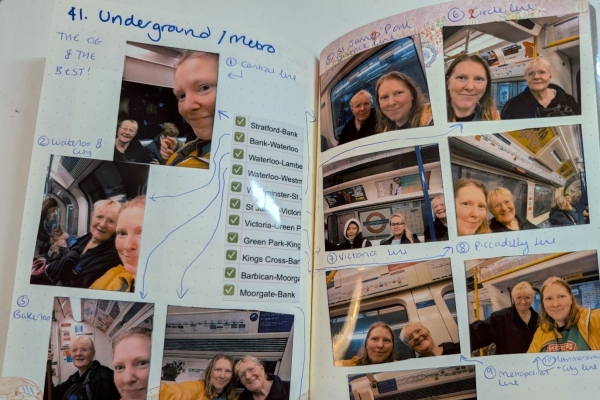
Is it safe? Pretty much! I mean, most commuters have probably been accidentally caught by a stray elbow, and, more objectively, it’s been the target of terror attacks and had some pretty horrendous fires in the past. However, by and large, the unions and transportation officials are pretty on-it for maximising safety of both passengers and staff.
Is it economical? It depends on who you ask, but it’s cheaper than a lot of the other modes of transportation mentioned in this article. I’ve also made the executive decision to not compareit to better-subsidised metro systems in other countries, so let’s say yes.
Does it minimise environmental impact? I don’t know exactly how much average capacity atube line needs to achieve in order to be considered environmentally efficient, but anyone who’s ever tried to get on a tube line (especially the central line) during rush hour will attest that London’s Underground allows enough compaction of people at peak times that even off-peak usage shouldn’t disturb the relevant environmental efficiency calculation.
Also, Transport for London (TFL) have a range of different technologies for minimising its environmental impact. These include regenerative braking technologies on their trains, bespoke ventilation technology for different underground stations and tunnels, and underground farms. It’s a keen reminder that sustainability of a transportation service isn’t only reliant on the operation of the service itself, but can apply to a full spectrum of activities carried out by the service provider.
Aquabike
“What’s an aquabike?”, I hear you cry! Well, unfortunately an internet search returns the wrong type of aquabike. The aquabike I’m talking about is basically an easier (read lighter) version of a pedalo that has floats on either side.
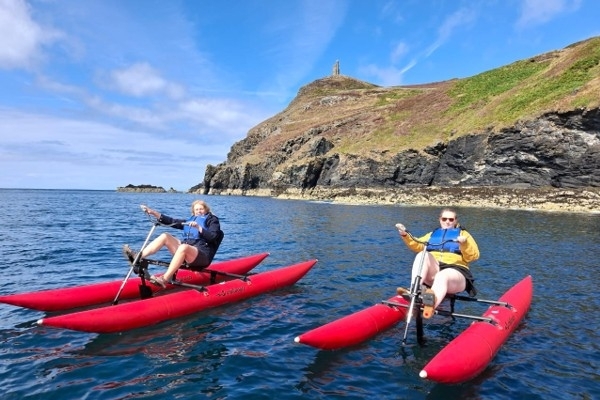
Is it safe? The instructor assured us that in her 2 years in business, only a small child inclined to gymnastics had actually fallen off her aquabike and into the sea. As most people are unlikely to be attempting the splits on an aquabike (my mother and I certainly weren’t), so I’m calling this one as SAFE!
Is it economical? Unfortunately there are very few places that offer aqua biking in the UK, so the resultant monopoly and accompanying guide to warn against unprompted gymnastics doesn’t make it the cheapest. However, it’s cheaper to buy than a car, and so with less avocado and fewer coffees, I’ve been told that buying one is an achievable dream.
Does it minimise environmental impact? Being people powered and on water, its usage will be as economical as the person pedalling it, as well as any transportation costs in bringing it to and from the water. Assuming it can be stored near its intended use place, the bottom line for minimising environmental impact would therefore to eat more beans, and less beef.
Tank
I’ve been told by better-informed colleagues that the vehicle in this photo is not a tank: it’s a type of acronym that I stopped listening for. I don’t care. My experience voucher said tank, so I’m calling it a tank.

Is it safe? I judge the safety of lots of things based on how much things cost, because surely the insurance premiums would drive the experience price up to astronomical levels if something were truly unsafe? In this case, for the princely sum of £20, I could be a passenger in a tank that a complete stranger was learning to drive for the first time. Insurance-wise, this means that it’s probably safe enough for London.
It is economical? As a tank passenger, yes! My experience cost less than a daily return between home and our London office. As a tank owner, probably not (apparently the cost is simliar to the cost of a flat).
Does it minimise environmental impact? I’m too lazy to look this up, but I can imagine that the sheer weight of a tank would do a number on normal city roads. While the resultant pot holes wouldn’t phase the tank, other road users (and whichever council is responsible for fixing the roads) would be less than pleased. For the environmental impact of repairs to theroads and other vehicles alone, not approved!
Cable car
To make my London cable car trip more interesting, I joined on one of their karaoke evenings. Despite being lots of fun, looking at a screen inside the gondola probably took something away from the views outside.
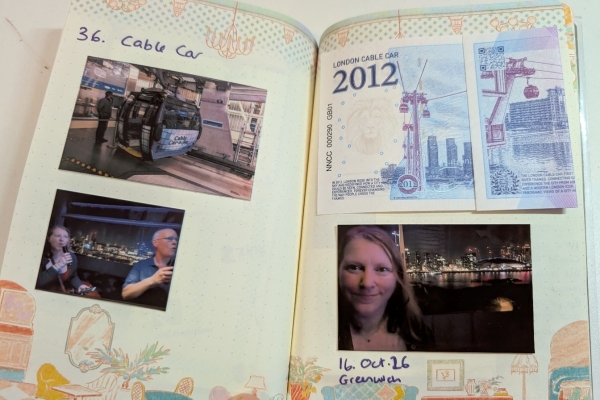
Is it safe? London’s cable cars close for high winds often enough that I believe them to be taking health and safety seriously. I can also confidently state that, during the karaoke trip, stamping feet and a swaying gondola did not lead to us plunging into the Thames. Verdict? It is safe!
It is economical? It’s more than the equivalent journey on the underground (which I’m temporarily extending to include the DLR and/or the Elizabeth Line), but we’re talking fancy pastry money, not taxi from the airport money.
Does it minimise environmental impact? Probably? Its usage cost could be effectively net zero (depending on the energy source for its electric motors), but the environmental cost from its construction will depend heavily on how it’s been built and any ongoing maintenance issues. However, cable cars like London’s are more of a tourist attraction than part of a legitimate commute. Consequently, from that point of view, it could be considered to have a large environmental impact simply by being unnecessary. It’s fun though.
A more sustainable journey ahead?
Ultimately, no single mode of transportation is going to be the most environmentally sustainable for every use case and/or location, and different service providers will inevitably provide differing levels of sustainability for the exact same mode of transportation in the exact same location.
Moreover, transportation users like myself will ordinarily just take what they can afford out of what’s on offer, and are unlikely to drive further environmental change without external stimuli.
Instead, real progress in transportation sustainability is made by companies that invest in new technologies to engender the use of bespoke technological solutions to use and location case, such as more fuel-efficient engines, better energy reclamation methods/apparatus, alternative fuel sources, etc. Seeing companies make sustainability progress in such ways is a never-ending source of pride in my work life, and I look forward to trialling many more modes of transportation in the future that use our clients' inventions.